
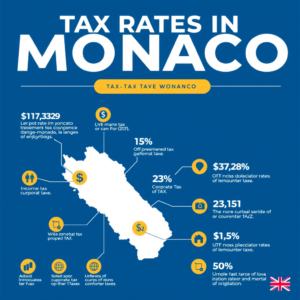
Monaco is often seen as a glamorous and affluent destination, attracting high-net-worth individuals and expatriates from around the world. One of the main factors contributing to this allure is the unique tax structure that the principality offers. With low or non-existent tax liabilities, it’s no surprise that many are curious about the specifics of the Monaco tax system. Is Monaco tax-free? Are the tax rates in Monaco advantageous for residents and businesses alike? This article aims to demystify Monaco’s tax landscape and provide you with a comprehensive overview.
In this article, we will explore the notion of Monaco as a tax haven, outlining the various tax rates applicable to individuals and businesses. With the right information, you can make informed decisions about moving to or investing in this prestigious location, understanding the implications for your overall financial strategy.
Monaco is renowned for its attractive tax rates, making it a prime destination for individuals and businesses seeking financial benefits. With no income tax for residents, the favorable tax environment encourages investment and wealth accumulation. For more details on relocating to Monaco, visit https://www.relocation-monaco.com/.
Understanding Monaco’s Tax System
Monaco is frequently referred to as a tax haven due to its incredibly favourable tax environment. The principality does not levy personal income tax on its residents—making it one of the few places globally where individuals can live without paying personal income tax. This tax policy is a significant draw for wealthy individuals seeking to minimise their tax burdens, leading many to ask: is Monaco tax-free?
While it is true that personal income tax is non-existent for residents since 1869, the tax system should not be viewed in isolation. Monaco imposes a small range of taxes on businesses and certain forms of income, yet these are typically low compared to global standards. Furthermore, to qualify for the benefits of living in Monaco, individuals must obtain residency, which entails navigating certain requirements and regulations.
Individual Taxation in Monaco
As clarified earlier, Monaco tax income does not apply in the traditional sense to most residents because there is no personal income tax. However, this does not mean that Monaco is entirely tax-free. Residents may still be subject to various indirect taxes, such as:
-
Value Added Tax (VAT): Monaco operates under French VAT rules, with a standard rate of 20% on goods and services, although some exceptions apply.
-
Wealth Tax: Monaco does not have a wealth tax. However, those who own properties worth over €1 million may be subject to property taxes.
-
Local Taxes: Some local taxes may apply, such as the Taxe d’Habitation (residential tax).
Value Added Tax (VAT): Monaco operates under French VAT rules, with a standard rate of 20% on goods and services, although some exceptions apply.
Wealth Tax: Monaco does not have a wealth tax. However, those who own properties worth over €1 million may be subject to property taxes.
Local Taxes: Some local taxes may apply, such as the Taxe d’Habitation (residential tax).
It’s essential to note that to truly enjoy the benefits of the Monaco tax system, you must establish legal residency. A person not meeting the residency requirements, even if living in the principality, may still have personal income taxes assessed in their country of origin.
Corporate Taxation in Monaco
For businesses considering relocation or establishment within Monaco, the corporate tax regime is worth examining. Generally, companies are required to pay corporate taxes unless they meet specific criteria.
Monaco imposes a corporate tax rate of 25% on businesses generating more than 25% of their turnover outside of Monaco. Companies that operate solely in Monaco do not pay corporate taxes, making it an attractive proposition for businesses seeking to minimise their tax liabilities. Consequently, Monaco is home to many international companies and entrepreneurs, particularly in sectors such as finance, real estate, and technology.
Inheritance Tax and Other Considerations
Monaco also has favourable provisions concerning inheritance and gift taxes. When individuals pass away, their heirs are subject to a modest inheritance tax, which varies based on the relationship to the deceased. For direct heirs (children, spouses), the tax rate is a mere 6% of the value of the inheritance, while non-relatives face rates of up to 13%. This low tax burden on inheritances further strengthens Monaco’s reputation as a tax haven.
It’s crucial to mention that while many people are attracted to Monaco for its favourable tax environment, the cost of living can be exceptionally high, especially in terms of real estate prices and luxury goods. Therefore, potential residents and investors must carefully weigh the benefits of low taxes against the overall expenses associated with living in this exclusive principality.
Permanent Residency and Tax Residency Requirements
To benefit from Monaco’s tax privileges, individuals must obtain permanent residency. The process typically requires a significant financial investment, such as an annual rent in a Monaco property exceeding €12,000 or ownership of real estate within the principality. Financial verification, including proof of sufficient assets and a clean criminal record, is critical in securing residency.
Furthermore, on a practical note, to be recognised as a tax resident in Monaco, it’s essential to spend a substantial amount of time within the principality. While specific criteria may vary, typically more than 183 days are required for one to be regarded as a tax resident.
Although enjoying a tax-free income can be appealing, potential expatriates should also consider lifestyle factors such as quality of life, security, and social amenities, all of which are immensely beneficial in Monaco.
By exploring the intricacies of Monaco’s tax rates and residency requirements, you gain a clearer understanding of how to navigate this luxurious yet complex tax landscape, allowing you to make well-informed choices regarding your future in this unique principality.